Astronomy
First-cycle bachelor’s degree programme
Study programme documentation (in Polish)
STUDY PROGRAMME IN FORCE FROM THE 2023/2024 ACADEMIC YEAR
-
2023 ASTRONOMY-1: Learning outcomes pdf 99 KB
-
2023 ASTRONOMY-1: Coverage of PRK characteristics pdf 84 KB
-
2023 ASTRONOMY-1: Study programme pdf 340 KB
-
2023 ASTRONOMY-1: Directional effects coverage matrix pdf 286 KB
-
2023 ASTRONOMY-1: Course content pdf 178 KB
-
Resolution No. 160/2023 of the Senate of the University of Wrocław on the Astronomy degree programme pdf 1 MB
STUDY PROGRAMME IN FORCE FROM THE 2019/2020 ACADEMIC YEAR
-
2019 ASTRONOMY-1: Learning outcomes pdf 123 KB
-
2019 ASTRONOMIA-1: Coverage of PRK characteristics pdf 98 KB
-
2019 ASTRONOMY-1: Study programme pdf 531 KB
-
2019 ASTRONOMY-1: Directional effects coverage matrix pdf 391 KB
-
2019 ASTRONOMY-1: Course content pdf 179 KB
-
Resolution No. 133/2019 of the University of Wrocław Senate on degree programmes at the University of Wrocław pdf 126 KB
-
Appendix No. 8 to Resolution No. 133/2019 pdf 510 KB
Study programmes for subsequent cycles of study (in Polish)
CYCLE OF STUDY 2025-2028
CYCLE OF STUDY 2024-2027
CYCLE OF STUDY 2023-2026
CYCLE OF STUDY 2022-2025
CYCLE OF STUDY 2021-2024
CYCLE OF STUDY 2020-2023
CYCLE OF STUDY 2019-2022
Summer observation placement
Summer student placements at the Observatory of the Institute of Astronomy, University of Wrocław, in Białków (Academic year 2025/2026)
Location: The Astronomical Observatory of the University of Wrocław in Białków near Wińsko, Wińsko municipality, Wołów district (approx. 70 km from Wrocław). Address: Białków 9, 56-160 Wińsko.
Duration of the placement: 120 lecture hours (lh)
The summer placement programme is divided into two sessions, each lasting 15 days (15*8 lh = 120 lh). Students are required to pass only one of them.
Note! Whether a particular session runs depends on whether the minimum number of students have registered for it (4). If there are not enough students, the work placement programme may be reorganised (cancellation of one of the sessions, automatic transfer of students). Due to accommodation constraints, we are only able to accommodate a maximum of 8 people at any one time.
SESSION I : 29 VI — 13 VII 2026,
SESSION II : 14 VII — 28 VII 2026.
Note! Students are obliged to arrive in Białków on the first day of their session before 12:00 PM (i.e. on 29 VI or 14 VII) and leave the observatory by 12:00 PM on the day following the final day of the session (i.e. 14 or 28 VII).
Note! Classes take place on a continuous basis, i.e. including Saturdays and Sundays.
Placement programme
Students taking part in the placement as part of a given session will be split in two groups and carry out two programme blocks, 60 lh each, in astrophysics and heliophysics. Transition from the helio- to astrophysics section and vice versa will take place after 7 days.
Astrophysics block (60 lh):
Astrophysicists in Wrocław focus mainly on variable stars, which they study using methods known as asteroseismology. This technique, which is developing at an ever-increasing pace and allows us to ‘peek’ inside stars, may soon help us gain a much better understanding of the physics behind the evolution of certain stars, particularly massive ones. Specialists in this field will conduct selected classes from the list below.
- Planning and conducting astrophysical observations.
- Research programmes carried out at the IA UWr.
- CCD camera observations, in particular of open and globular clusters.
- Calibration of CCD images (CCD camera, bias, dark current, sensitivity distribution).
- An introduction to stellar photometry.
- Photometric reduction of CCD images (direct and indirect photometry, aperture and profile photometry): the DAOPhot package.
- Conversion of brightness to the standard system.
- The creation and interpretation of colour-magnitude and double-index star cluster diagrams.
- Searching for variable stars: Fourier analysis of light curves.
- Satellite photometry.
- Remote observations using telescopes in Chile/Arizona/the Canary Islands.
- Age-related changes in the periods of RR Lyrae and Cepheid stars of Population II.
- An introduction to IRAF.
- Calibration and reduction of archived spectroscopic observations of selected stars.
- Determination of the radial velocities of the stars under study using the cross-correlation method.
- Lectures and practice on the structure and evolution of stars.
- An introduction to modelling stellar evolution using the MESA programme.
- An introduction to astroseismology.
- Poland’s participation in the SALT project (lecture) and draughting of an application for observation time (workshop).
- Astrophotography (fieldwork) and determining atmospheric refraction (workshop).
Heliophysics block (60 lh):
The Institute of Astronomy at the University of Wrocław is Poland’s largest centre specialising in solar physics. Experts in this field will conduct selected classes from the list below.
- Basic observational instruments – construction, operating principles, operation and observer safety.
- An Introduction to Solar Physics — the nearest star and active phenomena on the Sun.
- Simple routine heliophysical observations using a horizontal telescope, and filtrograms of prominences and solar flares.
- Filtrogram observations of solar prominences and active regions carried out using the Large Coronagraph.
- Observations of active phenomena (protuberance eruptions, solar flares) using the MSDP imaging spectrograph.
- Participation in ongoing observational programmes.
- Methods for analysing heliophysical observations – processing of self-conducted observations.
- Determination of key parameters of the coronal plasma from X-ray observations – a study using satellite data.
- A lecture on satellite observations of X-ray sources using coded apertures.
- Exercises on the reconstruction of X-ray images of the Crab Nebula and solar flares, photometry, and the analysis of changes in the positions of sources as a function of time and energy.
- Analysis of X-ray spectra using the OSPEX software package – with and without spatial resolution, using RHESSI and FERMI observations as examples.
- A lecture on observations of the Sun in the EUV and SXR bands.
- An interdisciplinary lecture on the impact of the Sun’s evolution on the Earth.
- Workshop: analysis of data from the AIA instrument on the SDO satellite – determination of the geometric and kinematic parameters of active phenomena observed in the EUV range.
How to get there
The Observatory is located in a small village of Białków, near the road connecting Żmigród and Wińsko.
Coordinates: 51o 28′ 34.6″ N, 16o 39′ 22.2″ E .
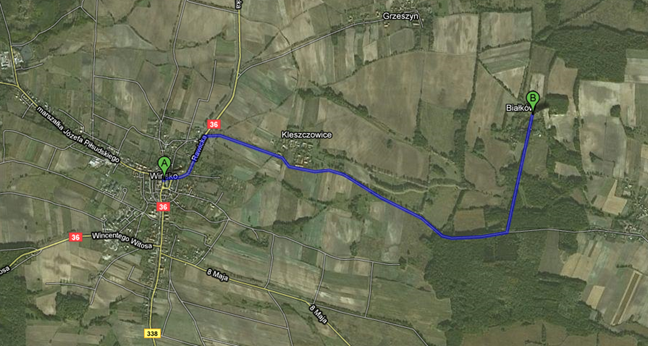
Access by public transport (bus only) is difficult. We don’t know schedules, perhaps currently there is no direct connection from Wrocław to Wińsko and a round trip, e.g. to Lubin, from where there is a bus to Wińsko, is necessary. After arriving in Wińsko you will need to walk about 4 km to Białków. Please check buses to Wińsko a few days in advance, e.g. on e-podroznik.pl
The best way to get there is by car. There is a car park on site.
If you have any difficulties with travel or any questions regarding accommodation or social services, please contact the following directly:
e-mail: grzegorz.kopacki@uwr.edu.pl (session I)
e-mail: krzysztof.radziszewski@uwr.edu.pl (session II)
New road – S5
If travelling by car, head to Żmigród, which is situated on the Wrocław–Poznań route (S5). At the junction, take Road 339 towards Żmigród. After a few hundred metres, you’ll see a sign indicating a left turn towards Wińsko. It’s about an 18-kilometre drive. We advise you to drive carefully on this stretch of road. There are some rather surprising bends in a few places. In the village of Stryjno, look out for the sign indicating a right turn: Białków 2 (please don’t be misled by the way this road is labelled, for example on Google Maps; it’s new and fully tarmacked; it’s best to check opentopmap.org).

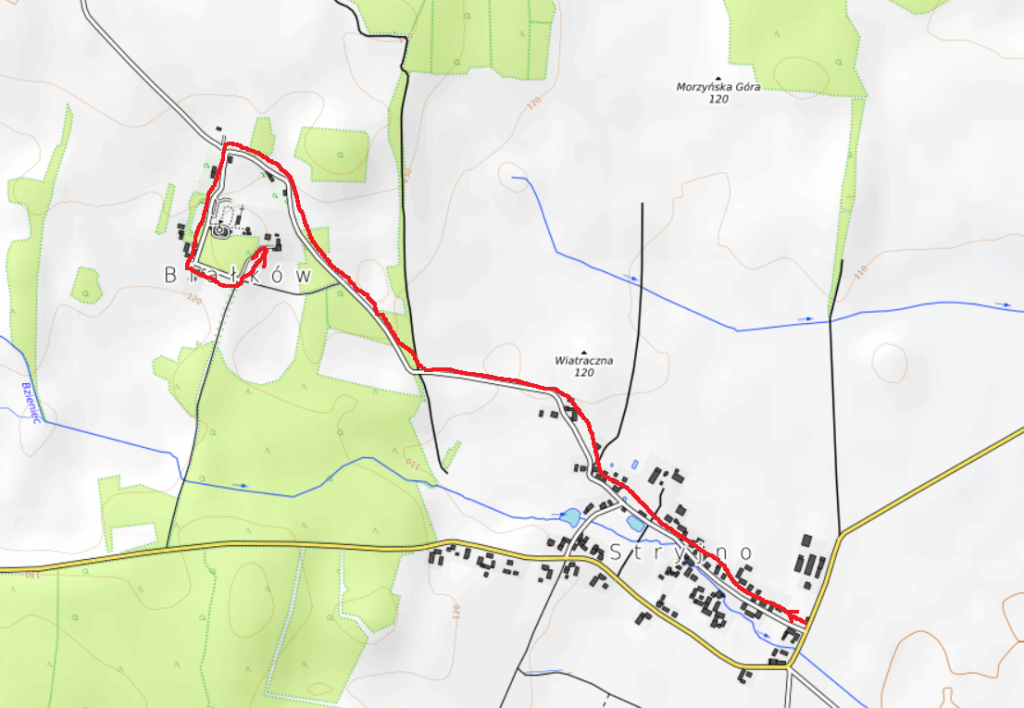
If travelling by public transport, you should get off at Wińsko and then walk about 4 km to Białków.
Accommodation conditions
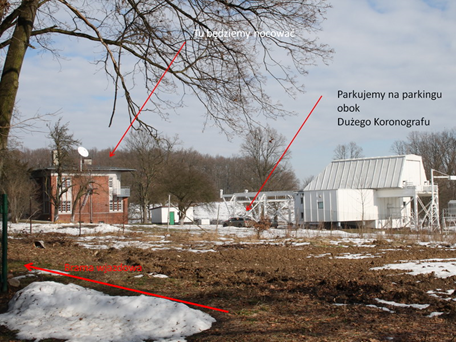
We provide free accommodation at the Observatory. The conditions on site are very good. The villa, which comprises guest rooms, a kitchen and a bathroom, has been thoroughly refurbished. At students’ disposal are two rooms; there are two bunk beds in each, which means that 4 people will be accommodated in one room. We provide duvets, pillows and blankets. It’s necessary to take your own bedsheets or a sleeping bag. The accommodation features a well-equipped kitchen with a fridge, microwave, ceramic hob and oven, however there is npo, więc wszystkie posiłki trzeba przygotować we własnym zakresie. Nie ma też pralki. Dobrze zaopatrzone sklepy znajdują się w Wińsku, nieco bliżej jest mały wiejski sklep w Stryjnie.
W budynkach Obserwatorium istnieje dostęp do bezprzewodowego internetu, drukarki i komputera. Można przywieźć ze sobą laptopy. Szybkość łącza internetowego nie jest jednak wysoka, więc funkcjonalność połączenia jest ograniczona.
W razie problemów z dojazdem proszę dzwonić do Obserwatorium, 71 389-80-24, ewentualnie do godz. 15:00 do sekretariatu Instytutu Astronomicznego we Wrocławiu, 71 337-80-60
Course syllabuses (in Polish)
-
A-1: Algorithms and programming pdf 121 KB
-
A-1: Mathematical analysis 1 pdf 136 KB
-
A-1: Mathematical analysis 2 pdf 117 KB
-
A-1: Mathematical analysis 3 pdf 173 KB
-
A-1: Observational astrophysics 1 pdf 115 KB
-
A-1: Observational astrophysics 2 pdf 87 KB
-
A-1: Astrophysics of planetary systems pdf 131 KB
-
A-1: Astronomical databases pdf 88 KB
-
A-1: Stellar structure and evolution pdf 112 KB
-
A-1: Observation exercises 1 pdf 96 KB
-
A-1: Observation exercises 2 pdf 100 KB
-
A-1: Electricity and magnetism pdf 137 KB
-
A-1: Elements of Theoretical Mechanics and ODE pdf 116 KB
-
A-1: Waves pdf 117 KB
-
A-1: Physics of the atom, the nucleus and elementary particles pdf 97 KB
-
A-1: Quantum physics pdf 147 KB
-
A-1: History of astronomy pdf 140 KB
-
A-1: Programming workshop pdf 125 KB
-
A-1: Foreign language course (B2) pdf 355 KB
-
A-1: Mathematics 1 pdf 96 KB
-
A-1: Mathematics 2 pdf 168 KB
-
A-1: Mathematics 3 pdf 111 KB
-
A-1: Mechanics pdf 150 KB
-
A-1: Mathematical methods in astronomy pdf 99 KB
-
A-1: Numerical methods pdf 80 KB
-
A-1: Intellectual property protection pdf 169 KB
-
A-1: Basics of entrepreneurship pdf 101 KB
-
A-1: Fundamental astronomy 1 pdf 131 KB
-
A-1: Fundamental astronomy 2 pdf 103 KB
-
A-1: Fundamental physics 1 pdf 109 KB
-
A-1: Fundamental physics 2 pdf 113 KB
-
A-1: Fundamental physics 3 pdf 115 KB
-
A-1: Fundamental physics 4 pdf 129 KB
-
A-1: Astronomical workshop pdf 110 KB
-
A-1: Mathematical methods computer laboratory 1 pdf 127 KB
-
A-1: Mathematical methods computer labortatory 2 pdf 127 KB
-
A-1: Heliophysics placement pdf 90 KB
-
A-1: Presentation of research findings pdf 134 KB
-
A-1: Bachelor’s seminar 1 pdf 108 KB
-
A-1: Bachelor’s seminar 2 pdf 109 KB
-
A-1: Astronomy seminar pdf 100 KB
-
A-1: Mathematical statistics pdf 136 KB
-
A-1: Stellar atmospheres theory pdf 153 KB
-
A-1: Thermodynamics pdf 102 KB
-
A-1: Website development pdf 101 KB
-
A-1: Summer observational placement pdf 153 KB
-
A-1: Introduction to IDL programming pdf 115 KB
-
A-1: Introduction to Python programming pdf 131 KB
-
A-1: Introduction to operating systems pdf 133 KB
-
A-1: Introduction to algebra pdf 136 KB
-
A-1: Introduction to Solar Physics pdf 102 KB
Second-cycle master’s degree programme
Study programme documentation (in Polish)
STUDY PROGRAMME IN FORCE FROM THE 2023/2024 ACADEMIC YEAR
-
2023 ASTRONOMY-2: Learning outcomes pdf 88 KB
-
2023 ASTRONOMY-2: Coverage of PRK characteristics pdf 85 KB
-
2023 ASTRONOMY-2: Study programme pdf 180 KB
-
2023 ASTRONOMY-2: Directional effects coverage matrix pdf 179 KB
-
2023 ASTRONOMY-2: Course content pdf 204 KB
-
Resolution No. 160/2023 of the Senate of the University of Wrocław on the Astronomy degree programme pdf 1 MB
STUDY PROGRAMME IN FORCE FROM THE 2019/2020 ACADEMIC YEAR
-
2019 ASTRONOMY-2: Learning outcomes pdf 204 KB
-
2019 ASTRONOMY-2: Coverage of PRK characteristics pdf 85 KB
-
2019 ASTRONOMY-2: Study programme pdf 193 KB
-
2019 ASTRONOMY-2: Directional effects coverage matrix pdf 214 KB
-
2019 ASTRONOMY-2: Course content pdf 130 KB
-
Resolution No. 133/2019 of the University of Wrocław Senate on degree programmes at the University of Wrocław pdf 126 KB
-
Appendix No. 9 to Resolution No. 133/2019 pdf 308 KB
Study programmes for subsequent cycles of study (in Polish)
CYCLE OF STUDY 2025-2027
CYCLE OF STUDY 2024-2026
CYCLE OF STUDY 2023-2025
CYCLE OF STUDY 2022-2024
CYCLE OF STUDY 2021-2023
CYCLE OF STUDY 2020-2022
CYCLE OF STUDY 2019-2021
Course syllabuses (in Polish)
-
A-2: Astrobiology (INT) pdf 111 KB
-
A-2: High-energy astrophysics pdf 107 KB
-
A-2: Galactic astronomy pdf 135 KB
-
A-2: Extragalactic astronomy pdf 95 KB
-
A-2: Stellar atmospheres pdf 144 KB
-
A-2: Stellar structure and evolution 2 pdf 140 KB
-
A-2: Classic electrodynamics pdf 149 KB
-
A-2: Physics of the solar flares (INT) pdf 111 KB
-
A-2: Solar Physics pdf 148 KB
-
A-2: Statistical Physics pdf 125 KB
-
A-2: Variable stars in globular clusters (INT) pdf 118 KB
-
A-2: Stellar nuclear reactions (INT) pdf 139 KB
-
A-2: Highlights of Modern Physics and Astrophysics pdf 126 KB
-
A-2: Solar corona pdf 112 KB
-
A-2: Cosmology pdf 95 KB
-
A-2: Foreign language course (B2+) pdf 334 KB
-
A-2: Celestial mechanics pdf 100 KB
-
A-2: Methods of reduction and analysis of astronomical data pdf 124 KB
-
A-2: Observations and modelling of the solar atmosphere (INT) pdf 145 KB
-
A-2: Space Weather (INT) pdf 104 KB
-
A-2: Laboratory of CCD photometry pdf 107 KB
-
A-2: IDL lab pdf 117 KB
-
A-2: Laboratory of spectroscopy pdf 103 KB
-
A-2: Applied Quantum Mechanics pdf 165 KB
-
A-2: Stellar Pulsation pdf 95 KB
-
A-2: Master’s Seminar 1 pdf 91 KB
-
A-2: Master’s Seminar 2 pdf 91 KB
-
A-2: Astronomy Seminar pdf 94 KB
-
A-2: Sun in the range of hard X-rays (INT) pdf 125 KB


