Astronomy
DO YOU HAVE QUESTIONS? WRITE TO US: rekrutacja.wfa@uwr.edu.pl
Explore the secrets of the Universe!
Bachelor’s degree in Astronomy
• Astronomy is a fascinating discipline of science that gives us an insight into the secrets of the Universe – from our cosmic backyard in the Solar System through inaccessible stellar interiors to the furthest corners of space and the beginnings of time.
• A distinctive feature of our programme is its unique, intimate atmosphere. A small number of students contributes to a personalised approach by instructors and more effective teaching and learning process.
• Studying astronomy stimulates development of creative thinking understood as the ability to solve problems in an innovative way based on logical reasoning.
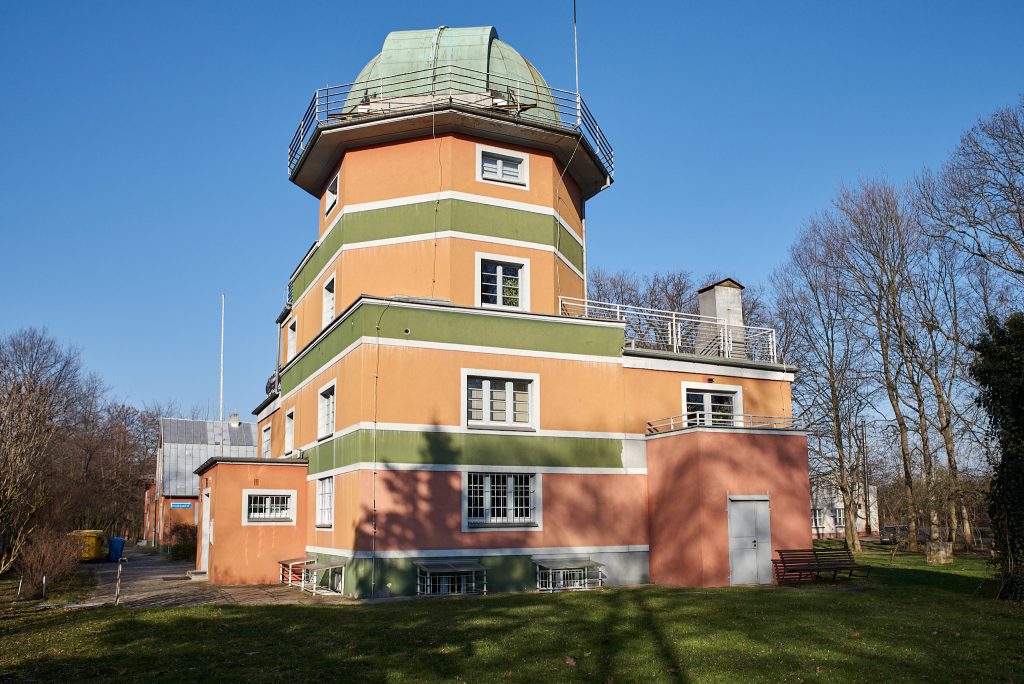
• An integral part of the Institute of Astronomy is the Observatory equipped with observation instruments that are unique on a global scale.
Who is it for?
• People interested in physical processes occurring on planets, in stars, galaxies, and other celestial bodies.
• Those who wish to find out how stars form, change, and end their “life” as white dwarfs, neutron stars, or even black holes.
• Those interested in observations of the Sun and other stars and methods of processing the data obtained to study phenomena occurring on the Sun and in stellar interiors.
• For people who wish to get involved in heliophysics and astrophysics research from the very start of their studies, as part of research projects carried out by scientists at the Institute of Astronomy.
• For active students wishing to develop their skills in any academic societies and student organisations, regardless of their field of study.
What skills will you acquire?
• Astronomy is one of the exact sciences, therefore during your studies you will gain a solid exact education based on the fundamentals of mathematics and physics, supplemented by astronomical knowledge of the structure and evolution of stars, stellar atmospheres, observational astronomy, the astrophysics of planetary systems, the physics of the Sun and the fundamentals of cosmology.
• You will learn to use astrophysical models to describe the processes taking place in astronomical objects.
• You will gain the ability to formulate scientific problems and become familiar with methods to solve them.
• On this course you will gain not only theoretical knowledge but also practical skills and you will learn how to use the knowledge gained in practice.
• You will become familiar with modern information technology relating, among other things, to the operation of operating systems, coding in Fortran and Python, creating websites, preparing presentations and publications using commonly used desktop publishing software.
• You will also gain a thorough knowledge of data analysis using statistical and numerical methods, useful in many non-astronomical applications.
What happens next?
• A degree in Astronomy will provide you with a solid foundation for a successful start to your career.
• With a well-rounded education in physics, mathematics, computer science, numerical methods and statistics, as well as the skill to solve complex problems, you will be able to start a career in research and development centres involved in modern technology, operating navigation, measurement, and diagnostic equipment, as well as companies involved in statistical analysis of data, finances and insurance, and the IT sector.
• Our graduates find employment at planetariums, in teams conducting satellite observations, and at science outreach centres.
• Completing a bachelor’s degree paves the way for further study at master’s level, followed by a PhD, and subsequently a research career in astronomy through internships at overseas centres and employment at universities or research institutes.
Mode of study: full-time
Duration: 3 years (first-cycle bachelor’s degree programme)
Language of instruction: Polish
Faculty of Physics and Astronomy
Master’s degree in Astronomy
• Astronomy is a fascinating discipline of science that gives us an insight into the secrets of the Universe – from our cosmic backyard in the Solar System through inaccessible stellar interiors to the furthest corners of space and the beginnings of time.
• A distinctive feature of our programme is its unique, intimate atmosphere. A small number of students contributes to a personalised approach by instructors and more effective teaching and learning process.
• Studying astronomy stimulates development of creative thinking which invcludes the ability to solve problems in an innovative way based on logical reasoning.
• An integral part of the Institute of Astronomy is the Observatory equipped with observation instruments that are unique on a global scale.
Who is it for?:
• People interested in physical processes occurring on planets, in stars, galaxies, and other celestial bodies.
• People who wish to learn theoretical modelling of the evolution of stars and their pulsation-induced variability; for those interested in detailed hydrodynamic models describing the phenomena occurring in the Sun’s atmosphere.
• For enthusiasts of observing the Sun and other stars, and for those wishing to learn advanced methods of processing photometric and spectroscopic data in order to study phenomena occurring on the Sun and within stellar interiors.
• For people who wish to get involved in heliophysics and astrophysics research, as part of research projects carried out by scientists at the Institute of Astronomy.
What skills will you acquire?:
• You will gain an in-depth knowledge and skills in astronomy including theoretical and observational astrophysics, heliophysics, and cosmology.
• During your studies you will develop skills necessary to take part in research.
• You will develop your skills in specific research techniques, in particular photometry and spectroscopy, as well as methods for the reduction and analysis of astronomical data.
• Whilst preparing your Master’s thesis, you will be involved in research projects carried out by one of the research teams at the Institute of Astronomy UWr.
• You will gain experience in both independent and team-based work and learn to interpret and present results of research.
• You will learn to use astrophysical models to describe processes occurring in astronomical objects as well as formulate scientific problems and find methods to solve them.
• During your studies you will also gain practical skills that will allow you to use the knowledge gained in real situations.
What happens next?:
• With a well-rounded education in physics, mathematics, computer science, numerical methods and statistics, as well as the skill to solve complex problems, you will be able to start a career in research and development centres involved in modern technology, operating navigation, measurement, and diagnostic equipment, as well as companies involved in statistical analysis of data, finances and insurance, and the IT sector.
• Our graduates find employment at planetariums, in teams conducting satellite observations, and at science outreach centres.
• Completing a mastyer’s’s degree paves the way for further study at PhD level and subsequently a research career in astronomy through internships at overseas centres and employment at universities or research institutes.
• Mode of study: full-time
• Duration: 3 years (second-cycle master’s degree programme)
• Language of instruction: Polish
• Faculty of Physics and Astronomy


