Electron–nucleus interaction cross sections determined using transfer learning
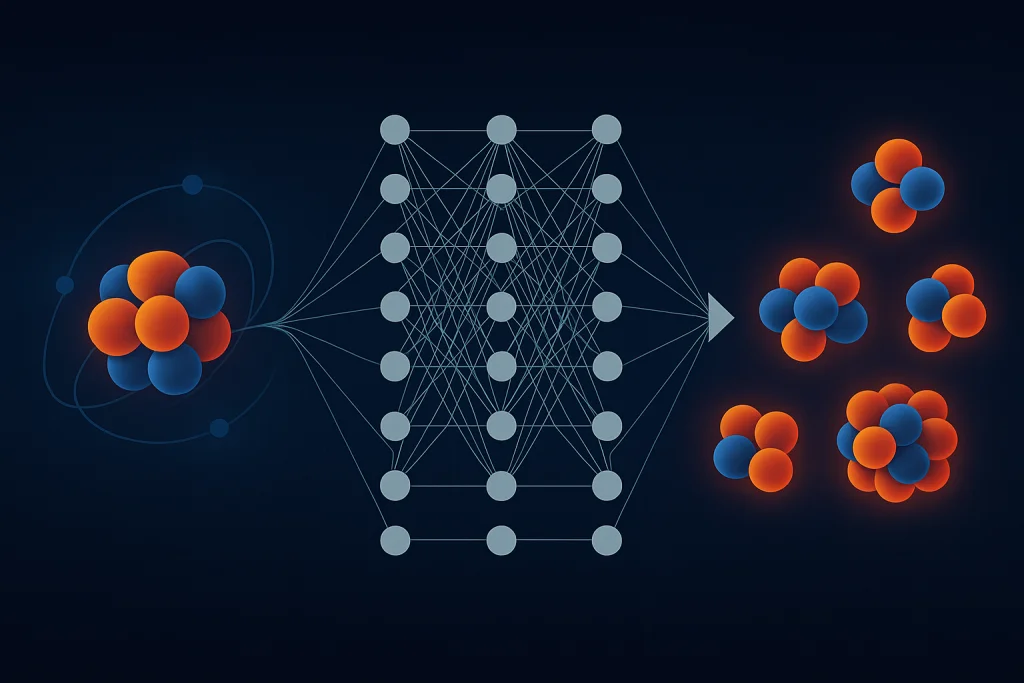
A paper titled Electron-Nucleus Cross Sections from Transfer Learning by a team from the Institute of Theoretical Physics has been published in the prestigious journal Physical Review Letters. The team’s work was coordinated by prof. Krzysztof Graczyk. The authors demonstrated that AI methods, in particular transfer learning, can be effectively used to describe electron interactions with atomic nuclei.
In the study, a deep neural network was trained on data from electron scattering measurements on carbon nuclei and then adapted to predict cross sections for other nuclei, from helium-3 to iron. A significant result of the work is that the model retains high accuracy also with a limited amount of data for new systems. This proves that the base model contains a representation encoding the basic properties of nuclear matter.
The obtained results open new possibilites of using AI tools in nuclear physics, especially where experimental data is incomplete. The work also has meaning for developing models of neutrino interactions with matter, important for experiments investigating the fundamental properties of the Universe.
Source:
K. M. Graczyk, B. E. Kowal, A. M. Ankowski, R. D. Banerjee, J. L. Bonilla, H. Prasad, J. T. Sobczyk, Electron-Nucleus Cross Sections from Transfer Learning, Physical Review Letters135(5), 052502 (2025), published 1 August 2025 r.


