
Szanowni Państwo,
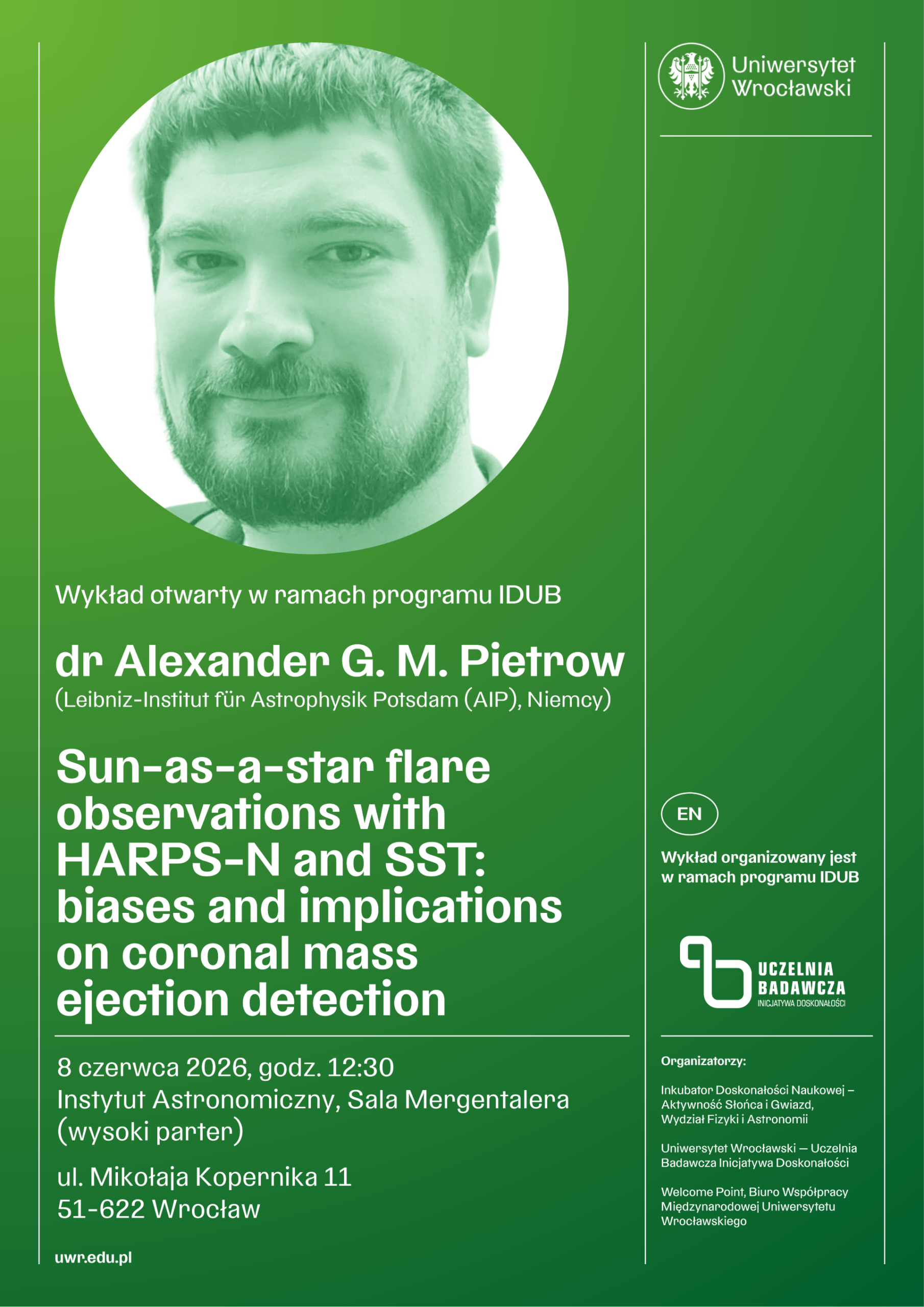
w imieniu doktora Aarona Peata reprezentującego Inkubator Doskonałości Naukowej – Aktywność Słońca i Gwiazd, Wydziału Fizyki i Astronomii UWr zapraszamy na wykład dr. Alexandra Pietrowa (NLeibniz-Institut für Astrophysik Potsdam (AIP), Niemcy), realizującego pobyt na Uniwersytecie Wrocławskim w ramach programu „profesorów wizytujących” projektu IDUB.
Dr. Alexander Pietrow is a Deutsche Forschungsgemeinschaft (DFG) Research Fellow at the Leibniz-Institut für Astrophysik Potsdam (AIP) whose research focuses on connecting solar and stellar astrophysics by leveraging spatially resolved solar observations to physically inform the interpretation of unresolved phenomena on other stars. This interdisciplinary work improves our understanding of stellar noise, the main limiting factor in detecting Earth-like exoplanets. Although primarily an observational astronomer, Dr. Pietrow combines his observations with state-of-the-art radiative transfer modelling and numerical simulations. These approaches allow him to infer the physical processes driving solar activity and translate them into Sun-as-a-star diagnostics, which can be compared to unresolved stellar observations such as those of exoplanet host stars.
Stellar flares cannot be spatially resolved, requiring complex three-dimensional behavior to be inferred from one-dimensional, disk-integrated spectra. Owing to their proximity, solar flares provide a crucial benchmark for interpreting their stellar counterparts, particularly when observed with a relatively new class of telescopes that integrate the full solar disk to produce Sun-as-a-star spectra directly comparable to stellar observations.
In this talk, I will introduce this class of instrumentation, present observations of several strong solar flares obtained with the HARPS-N Sun-as-a-star telescope, and further bridge the gap between resolved and unresolved observations by transforming high-resolution flare data from the Swedish 1-meter Solar Telescope (SST) into synthetic disk-integrated spectra.
Our results demonstrate a clear relationship between the temporal evolution of disk-integrated spectral line shapes and the location of flares on the solar disk, providing a pathway to constrain flare locations in stellar observations.


