Transfer learning for neutrino scattering: Domain adaptation with generative adversarial networks
We are pleased to inform that a paper by employees of the Institute of Theoretical Physics demonstrating that AI tools can help model the interactions of neutrinos with matter has been published in the journal Physical Review D.
The authors used the transfer learning method, i. e. transferring knowledge gained from one data set to the description of other, related physical processes. The study utilised generative adversarial networks (GAN) that were first trained on synthetic data concerning neutrino scattering on carbon and then adjustred to other cases, including interactions with argon and antineutrinos.
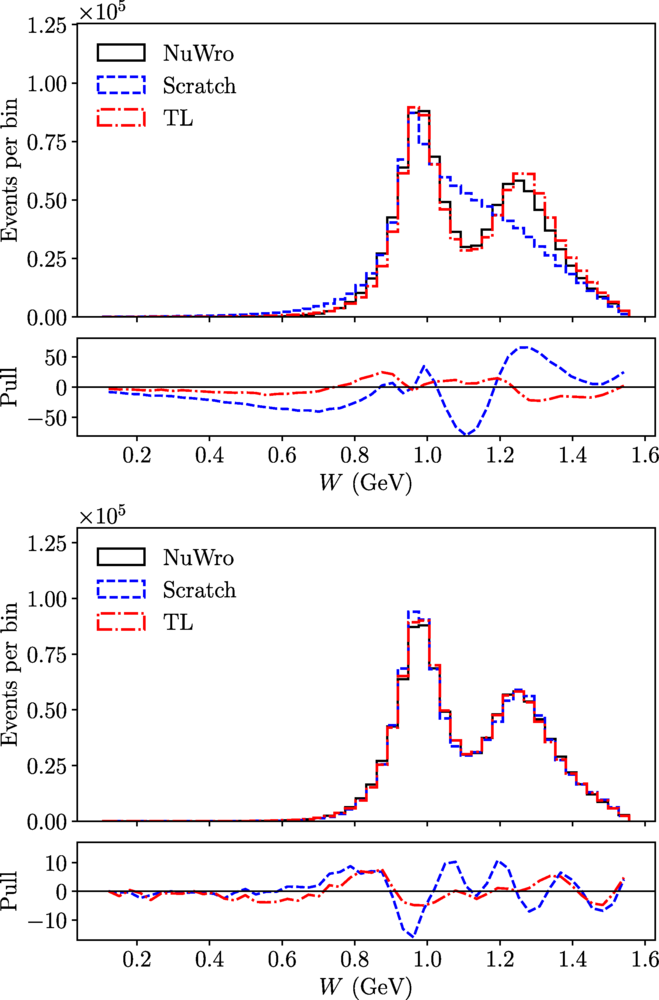
The work demonstrates that such approach allows to retain the most important physical features of analysed processes and simultaneously produces better results than training models from scratch. What is important, the advantage of this method was also visible when relatively small training data sets were available. This opens the way to creating faster and more elastic neutrino phenomena simulators, particularly important where experimental data is limited. These results are important for modern neutrino physics because the simulation accuracy directly influences the interpretation of experimental results.
Full bibliographic information: José L. Bonilla, Krzysztof M. Graczyk, Artur M. Ankowski, Rwik Dharmapal Banerjee, Beata E. Kowal, Hemant Prasad, and Jan T. Sobczyk, Transfer learning for neutrino scattering: Domain adaptation with generative adversarial networks, Physical Review D 113(5), 2026, DOI: 10.1103/kwjj-wp1c.
Figure: Reconstructed distributions of the invariant hadronic mass 𝑊 for a neutrino energy 𝐸𝜈 = 1 GeV and for inclusive charged current (CC) scattering 𝜈𝜇 on argon, generated by nuwro and a GAN model trained from scratch and using transfer learning (TL), for optimization using 10,000 (top) and 100,000 (bottom) events (top). Source: Phys. Rev. D 113, 053001


